
Want to improve your writing but don’t have the time or budget for a course? You don’t need one. The writers who improve fastest share a handful of daily habits, a commitment to honest feedback, and the right tools.
This guide covers all three — with practical strategies you can start using today.
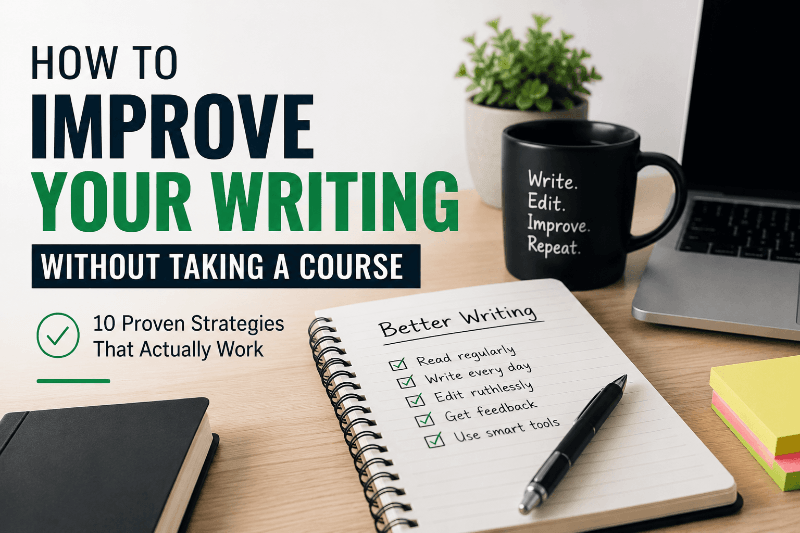
Whether you write emails, blog posts, work reports, or social media content, the difference between average and compelling writing comes down to repeatable practices — not expensive credentials. Let’s get into it.
1. Read Like a Writer
Reading is the original writing course — and it’s free. But there’s a meaningful difference between reading for information and reading like a writer. When you read like a writer, you pay attention to sentence rhythm, how paragraphs open and close, when a word choice surprises you, and why a piece holds your attention (or loses it).
Pick one article, essay, or chapter per day and annotate it — even mentally — asking: “Why does this work? What would happen if I changed the opening? Why did the writer choose this word over a simpler one?” Over weeks, your brain internalises patterns that no grammar textbook can teach.
Great writers to study for style: George Orwell (clarity), Joan Didion (rhythm), Paul Graham (plain logic), and Ann Lamott (warmth and honesty). You don’t need to read books — their essays and articles are freely available online.
82% of professional writers cite regular reading as the single most influential factor in developing their own voice and style. — National Writing Survey
2. Write Every Day — Even Briefly
Fluency in writing works the same way as fluency in a language: it demands repetition. You don’t need an hour a day. Ten minutes of free writing each morning — a journal entry, a half-formed idea, a summary of something you read — keeps the muscle warm.
Writers who write daily, even badly, consistently outpace those who write only when they feel “ready.” The blank page is less frightening when you face it every morning. The first few sentences stop feeling like climbing a wall and start feeling like habit.
“The first draft of anything is garbage.” — Ernest Hemingway. The point isn’t to write well on the first pass. It’s to write — so that editing has something to work with.
If you struggle with consistency, set a word target so low it feels embarrassing: 100 words. That’s two short paragraphs. Once you start, you’ll usually write more. The goal is to remove the friction of starting, not to produce a masterpiece before breakfast.
3. Edit in a Separate Pass
Most weak writing is simply under-edited writing. The problem is that most people try to write and edit at the same time — that’s like driving a car while simultaneously giving yourself turn-by-turn directions. It splits your attention at exactly the moment both tasks need it most.
Get your ideas down first. Step away for at least 30 minutes (ideally overnight). Then return with fresh eyes and a single goal: cut everything that doesn’t earn its place. Be ruthless. If a sentence doesn’t add meaning, move the reader forward, or add necessary texture — cut it.
Read your draft out loud. Your ear catches what your eye skips: the clunky transition, the repeated word two sentences apart, the paragraph that starts strong and wanders at the end. If you find yourself stumbling while reading aloud, that’s your signal to rewrite.
4. Cut Filler Words Ruthlessly
Weak writing hides behind filler. Qualifiers and hedging words pile up and drain the energy from your prose. These are the usual offenders: very, really, basically, quite, just, actually, somewhat, a little, kind of, sort of, in order to, due to the fact that.
Every one of those can be cut or replaced with a stronger alternative. “She was very tired” becomes “She was exhausted.” “I just wanted to say” becomes “I wanted to say.” “Due to the fact that” becomes “because.” Cutting filler isn’t losing words — it’s gaining precision and confidence.
A useful exercise: paste your latest draft into a document and use Find to search for “just,” “very,” and “really.” Delete every instance that doesn’t change the meaning. You’ll be surprised how many survive perfectly fine.
5. Study One Micro-Skill at a Time
Trying to fix grammar, structure, word choice, transitions, and clarity all at once is a recipe for frustration and slow progress. Instead, pick one skill and focus on it for two weeks:
W1 Week 1–2: Active vs Passive Voice
Find every passive sentence in your drafts and rewrite it in active voice. “Mistakes were made” ? “We made mistakes.” Stronger, clearer, more accountable.
W3 Week 3–4: Paragraph Structure
Every paragraph should have one job. Practice opening with your main point, supporting it in the middle, and closing with a transition or payoff line.
W5 Week 5–6: Headline & Opening Lines
The first sentence determines whether anyone reads the second. Practise rewriting your openers until they create an immediate reason to keep going.
W7 Week 7–8: Transitions
Abrupt shifts between ideas are a silent reader-repellent. Study how great writers guide you from one idea to the next without you noticing the seams.
Deep focus on one micro-skill produces faster, more durable improvement than scattered attention across everything at once. After two months of this approach, you will have meaningfully levelled up eight separate skills.
Let AI Catch What You Miss
Even experienced writers miss things. Typos slip through. Passive voice creeps in. Grammarly acts as a real-time writing coach by flagging errors and suggesting improvements.
It works across Chrome, Google Docs, Microsoft Word, Gmail, Slack and many other apps. The free plan covers grammar and spelling, while Premium adds clarity, rewrites and plagiarism detection.
Full-sentence AI rewrites
Style & conciseness suggestions
Browser, Word & Docs support
Plagiarism detection (Premium)
Works everywhere you type
Learns your personal style
Writing With vs. Without a Tool Like Grammarly
? Without Grammarly
- Miss subtle grammar errors
- Unclear tone goes undetected
- Passive voice slips through
- Repetitive words unnoticed
- No real-time feedback loop
? With Grammarly
- Errors caught as you type
- Tone suggestions in context
- Clearer, stronger sentences
- Explanation of every fix
- Builds skill while you edit
7. Get Real, Specific Feedback
Tools catch mechanical errors. Humans catch meaning problems — the argument that doesn’t land, the section that loses the reader, the conclusion that feels unearned. Share your writing with someone who will be honest: a colleague, a writing group, or an online community like Reddit’s r/writing or r/blogging.
The key is to ask specific questions. “Is the opening clear?” gives you useful data. “What did you think?” gives you nothing. “Did you lose interest anywhere — and where?” is gold. Vague praise (“it’s good!”) helps no one improve.
Pair human feedback with Grammarly and you close both loops simultaneously — fixing the mechanical in real time while a real reader catches the structural. That combination is faster and more effective than either approach alone.
8. Imitate Writers You Admire
Imitation is how every art form is learned before it’s transcended. Choose a writer whose style appeals to you and deliberately imitate them — not to plagiarise, but to understand the mechanics underneath their prose. Pick a paragraph you love and rewrite it with different content but the same structure. Then write an original paragraph in that same style.
This exercise forces you to reverse-engineer choices you would usually consume passively. After a few weeks of deliberate imitation, those patterns start showing up in your own voice — not as mimicry, but as new tools in your toolkit.
Writers worth imitating for specific skills: Hemingway for brevity, David Foster Wallace for complex rhythm, Annie Dillard for sensory detail, and Paul Graham for making hard ideas feel simple.
9. Avoid the Most Common Writing Mistakes
Knowing your recurring errors is half the battle. Here are the most common mistakes that hold writers back — and the fix for each:
| Mistake | Example | Fix |
|---|---|---|
| Passive voice | Weak “The report was written by her.” | Better “She wrote the report.” |
| Buried lead | Weak Three paragraphs of context before the main point | Better Open with your main point, then explain it |
| Overlong sentences | Weak Sentences that run on and on past 30 words and lose the reader | Better Keep most sentences under 25 words. Use short ones for impact. |
| Weak verbs | Weak “She made a decision to leave.” | Better “She decided to leave.” |
| Redundant phrases | Weak “end result,” “future plans,” “past history” | Better “result,” “plans,” “history” |
| Vague nouns | Weak “There was a lot of negativity in the room.” | Better “The team sat in silence, arms crossed.” |
If you use Grammarly, it flags most of these automatically and explains the fix — which means you learn the rule each time you correct it, rather than making the same mistake indefinitely.
10. Build a Writing Routine That Sticks
Motivation is unreliable. Routine is not. The single biggest predictor of writing improvement isn’t talent or technique — it’s showing up consistently. Here’s a simple daily routine that takes under 30 minutes and covers every element that drives growth:
A Simple Daily Writing
Thirty minutes a day, done consistently for 90 days, will produce more improvement than any weekend writing course. The key is that it’s daily — not occasional, not when you feel inspired, not when deadlines force it. Daily.
Bonus: Quick Wins You Can Apply Right Now
Keep a swipe file
Collect sentences and paragraphs you love in a running document. When your writing feels flat, read it to reset your standard.
Start sentences with the subject
Don’t bury who is doing what. “The team launched the feature” is stronger than “The feature was launched by the team.”
Use strong, specific verbs
“She hurried” beats “She walked quickly.” Precise verbs carry more information in fewer words.
Rewrite one old piece
Go back to something you wrote six months ago and rewrite it completely. The gap between old and new is your growth chart.
Frequently Asked Questions
Q1. How long does it take to noticeably improve your writing?
Most writers notice meaningful improvement within 4–8 weeks of daily practice. Dramatic improvement in clarity, structure, and confidence typically happens within 3–6 months. The key variable is consistency — daily practice of 10–15 minutes outperforms occasional longer sessions.
Q2. Is Grammarly worth it for a beginner writer?
Yes — arguably more so than for advanced writers. The free version catches grammar and spelling errors, while Premium adds explanations for every suggestion, which accelerates learning. Think of it less as autocorrect and more as a writing coach that’s always available. Try the free version here before deciding whether Premium is worth it for your needs.
Q3. Can you become a good writer without natural talent?
Yes. Writing is a craft, not a gift. Research on expert performance consistently shows that deliberate practice — not innate ability — is the primary driver of skill development. The writers who become excellent are, almost universally, the ones who wrote the most and studied their craft the longest.
Q4. What’s the single best thing I can do to improve my writing today?
Write one page — without editing — and then spend 15 minutes cutting it by 20%. You’ll learn more about your writing habits from that one exercise than from most how-to articles, including this one.
The Bottom Line
Improving your writing doesn’t require an enrollment form or a tuition payment. It requires showing up consistently, studying the craft deliberately, and building systems that surface your mistakes before your readers do.
The strategies in this guide — reading analytically, writing daily, editing separately, cutting filler, focusing on micro-skills, getting honest feedback, imitating great writers, avoiding common mistakes, and building a routine — compound over time. Each one makes the others more effective.
And for the mechanical layer — the grammar slip, the passive voice you didn’t notice, the sentence that could be 40% shorter — Grammarly handles that in real time, so your attention stays where it belongs: on saying something worth reading.
Start with one habit from this list. Do it for two weeks. Then add another. Your writing won’t transform overnight — but it will transform.